

How Mindfulness Practices Can Enhance Your Therapy Experience
The use of mindfulness techniques in therapy is an essential tool for the therapist as well. Mindfulness in therapy has been defined by Empower Therapy Wellness professionals as one of our most powerful personal resources. The capacity to respond to the client’s need or internal energy with intention, as opposed to simply reacting to what the emotional energy of the room is calling for. For the clinician and the client, mindfulness allows a safe, spacious environment in which to do the heavy lifting for transformation with respect and focus.
What is Mindfulness in Therapy
Mindfulness in therapy means, simply, maintaining one’s thoughts, emotions, or experiences in a present moment by moment way. These practices have been used for centuries, but mindfulness has quickly taken center stage in the modern treatment arena because it simply works. This scientifically proven method will rewire your brain to deal with your emotions in a more positive way.
Mindfulness in therapy will make you hold, observe, and think of how to respond instead of reacting to an uncomfortable thought. It creates the ability to watch your inner and outer environment with curiosity instead of judgment.
- Thoughts: Observing them as they drift by like clouds and not becoming entrapped in them.
- Emotions: Noticing what you feel but not labelling the feeling as good or bad.
- Physical Sensation: Becoming aware of tension, temperature, breath pattern, etc.
- Environment: Seeing, hearing, feeling the world how it is in the present.
Types of Mindfulness in Therapy
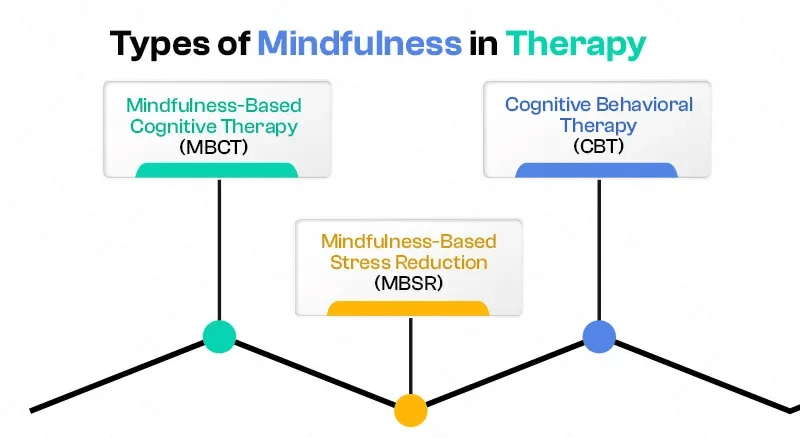
Mindfulness-Based Cognitive Therapy (MBCT)
It is a highly effective combination of conventional talk therapy and meditation techniques. This therapy emphasizes cognitive restructuring, which involves the identification of thinking patterns and the intentional adoption of a more constructive outlook. The 3-minute breathing space is an essential component of this therapy. Here is the self-checking technique that can be practiced anywhere and at any time:
- Acknowledge: Take a moment to check in with yourself, which helps you recognize your current thoughts and emotions.
- Gather: Move your attention completely to your breath, which helps to gather your emotions.
- Expand: Broaden your awareness back out to your whole body, noticing how those initial feelings are manifesting physically.
Cognitive Behavioral Therapy (CBT)
Although mindfulness-based CBT is sometimes used synonymously with MBCT, mindfulness-based CBT is very focused on the behavioral part of the equation. It creates a connection between what we think, how we feel, and what we do. By incorporating mindfulness into CBT, you get the pause button that allows you to recognize a negative thought before it becomes a self-defeating behavior.
Mindfulness-Based Stress Reduction (MBSR)
If your aim is to turn down the volume on chronic stress or manage the physical symptoms of a chronic illness, then MBSR is probably the way to go. Originally developed for clinical settings, it uses a specific protocol of stress-management techniques like body scans and gentle movement to help people navigate physical pain and emotional pressure with more resilience.
Effects of Mindfulness in Therapy
- Reduce Anxiety and Stress: By decreasing cortisol and slowing heart rate, it serves as a brake on a racing mind. This is the foundation of Mindfulness-Based Stress Reduction (MBSR) and rebalancing the emotions.
- Emotional Self-Regulation: It is a part of the therapy that allows you to remain present with challenging emotions and respond with intention and self-compassion instead of impulsively.
- Physical resilience: The benefits go under the skin to lower blood pressure, improve immune function, and calm chronic inflammation.
- Improve Sleep: Mindfulness reduces your physiologic arousal so you can fall asleep naturally and improve your sleep hygiene.
Mindfulness Practices You Can Do Between Sessions
- Body Scan: Review your sensations internally from head to toe. This allows you to see where you tend to hold your stress and release it before it builds up.
- 5-4-3-2-1 Technique: Rapidly list 5 things you see, 4 things you feel, 3 things you hear, 2 things you smell, and 1 thing you taste. This will bring you out of a cycle and back into the moment.
- Reflective Journaling: The act of writing your thoughts down, without judging yourself, helps you see emotional patterns and brings greater insight into your therapy.
- Intuitive Eating: This practice helps you develop a greater appreciation for food and create a more intuitive relationship with food and hunger.
Empower Therapy Wellness as Your Partner
At Empower Therapy Wellness, our therapists are trained to incorporate mindfulness practices. We offer comprehensive mental health solutions, provided by specialized professionals. Are you ready to embark on a journey of mindfulness in therapy? Contact our Empower Therapy Wellness team to help you on your journey towards personal growth and healing.